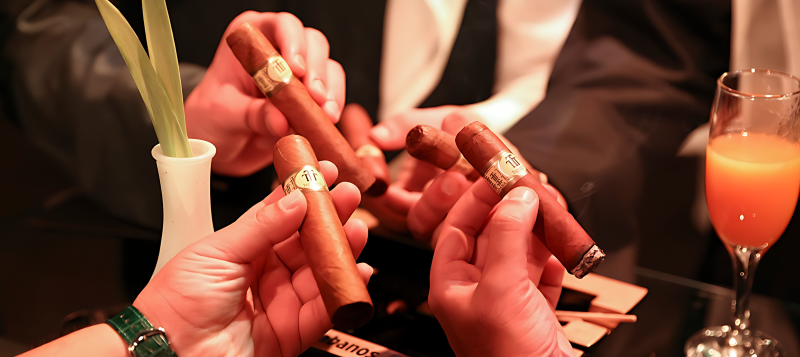
Cuban cigars have never existed in isolation. From their earliest days, they have been shaped not only by soil and craftsmanship, but by people—by shared spaces, collective rituals, and conversation. Long before Cuban cigars became objects of global admiration, they were already anchors of community.
That foundation remains relevant today, perhaps more than ever.
Community at the Heart of Cuban Cigar Culture
In Cuba, cigar culture developed as a communal practice. Tobacco was grown collectively, fermented with shared knowledge, and rolled in factories where workers spent long hours side by side. The introduction of the lector—the reader who recited novels, newspapers, and political texts aloud—transformed cigar factories into places of cultural exchange.
This tradition is well documented and central to Cuban cigar history. It reinforced a simple idea: cigars were meant to be experienced together. Ideas, stories, and debates traveled alongside the tobacco, creating a culture where smoking was inseparable from dialogue.
From Havana to the World
As Cuban cigars moved beyond the island, this communal spirit followed. In Europe and the Americas, Cuban cigars found a natural home in cafés, private clubs, and merchant houses. These were not merely retail spaces, but gathering points—places where news was exchanged, relationships formed, and rituals maintained.
Historic merchants in cities such as London, Paris, and Madrid played a critical role in sustaining Cuban cigar communities abroad. Their shops became informal cultural hubs, preserving both the material and social dimensions of the Habano.
Knowledge Preserved Through Conversation
Much of what defines serious Cuban cigar appreciation has been transmitted person to person. Storage practices, aging behavior, the nuances of vitolas, and the character of different tobacco-growing regions were not codified in manuals but shared through experience.
Even today, despite the abundance of online information, this knowledge remains most reliable when grounded in conversation. Cuban cigars are sensitive to environment and time, and understanding them fully often requires lived experience—something communities are uniquely positioned to provide.
Continuity in a Fragmented World
Modern life encourages speed and immediacy. Cuban cigars resist both. A Habano demands time, attention, and patience. This simple requirement shapes the spaces around it, favoring presence over distraction.
Cuban cigar communities—whether in lounges, private circles, or carefully moderated online spaces—continue to matter because they uphold these values. They create environments where silence is acceptable, where listening is valued, and where tradition is not dismissed as nostalgia but respected as continuity.
Digital Spaces, Cuban Roots
Online communities have expanded access to Cuban cigar culture, particularly for those far from traditional cigar centers. While digital spaces cannot replace physical rituals entirely, they have become important extensions of Cuban cigar discourse when guided by respect and accuracy.
What sustains these communities is not the medium, but the shared reference point: the Cuban cigar itself, with its history, standards, and cultural weight.
Why Cuban Cigar Communities Endure
Cuban cigar communities still matter because they preserve context. They protect meaning from dilution. In a global market increasingly driven by novelty, they maintain a connection to origin, craftsmanship, and shared memory.
They are not exclusive by nature, nor are they performative at their best. Instead, they offer continuity—between generations, across borders, and through time.
In gathering around Cuban cigars, people do more than smoke. They participate in a living tradition that values patience, exchange, and the quiet power of shared experience.